My Enquiry (0)
No artwork has been selected.
Please choose an artwork to enquire.
Enquiry Submitted
Thank you for your enquiry and interest in our artists’ work. A member of the gallery team will respond shortly.
000%


18 July - 10 September 2026
Kanye Nawe traces Zanele Muholi's ongoing commitment to visibility, memory, and collective care through landmark bodies of work.
Kanye Nawe: A Philosophy of Shared Presence
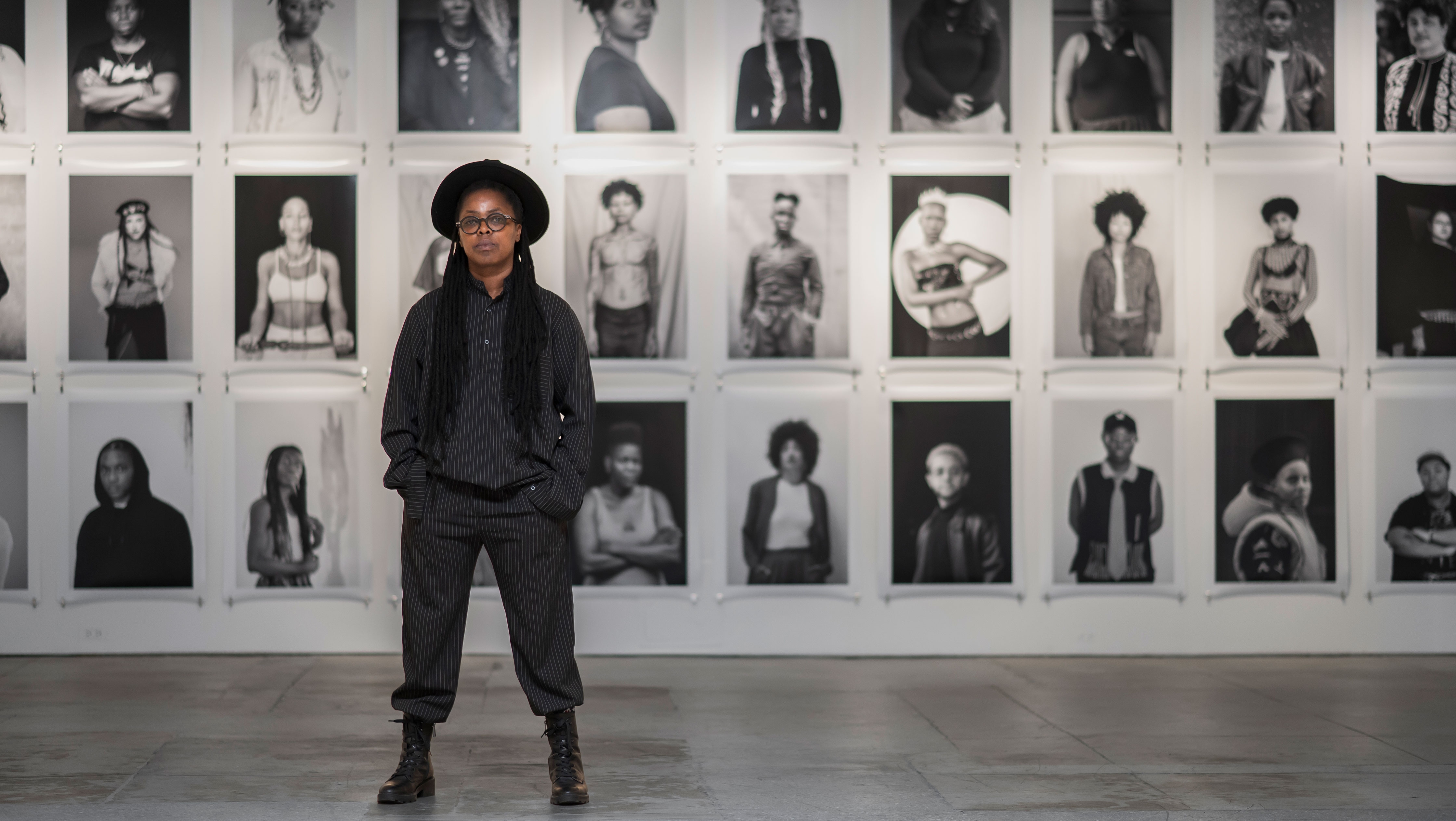
Kanye Nawe is a major solo exhibition by Sir Zanele Muholi that brings together landmark photographic series and recent bronze sculptures spanning more than two decades of the artist's practice. These bodies of work trace Muholi's sustained commitment to visual activism and reshape contemporary understandings of Black Queer visibility, intimacy, self-representation, and community.
The exhibition’s title is an isiZulu phrase meaning "with you," "alongside you," or, in its broadest sense, "oneness." I initially believed this to be a simple translation. That changed during a conversation with Muholi across time zones, while I was in Valencia for the Gay Games and they were in Mexico City for World Pride – both of us continuing the work of archiving Queer lives. When I asked about the title's meaning, Muholi responded by singing a gospel melody familiar to many Black mothers in moments of mourning and joy, prompting laughter and tears over the phone. In that moment, the title transcended language, revealing a deep sonic and ancestral resonance, and a philosophy of shared presence that anchors Muholi’s practice in collective authorship and acts of solidarity. Across its diverse formats, the exhibition unfolds through this spirit of togetherness, suggesting that identity is forged through continual exchange with ancestry, place, and those around us.
Central to the exhibition istheportraiture series, Faces and Phases (2006–ongoing). Conceived as a counter-narrative to the enduring legacies of colonialism and Apartheid, the project responds to what Gabeba Baderoon, drawing on Pumla Gqola, describes as "hostile visibility"[1]: the contradiction between progressive constitutional protections and the persistent violence faced by Black Queer people. Muholi initiated the project in 2006 – a watershed year marked by the passage of South Africa’s Civil Union Act, which legalised same-sex marriage.


Employing a consistent, frontal mode of portraiture, Faces and Phases foregrounds each participant’s individuality, agency, and dignity. The series began with a portrait of Muholi’s late friend Busi Sigasa, a poet and activist whose work confronted violence against Black lesbians and whose life embodied the urgency from which the project emerged. Photographed at Constitution Hill in Johannesburg – a site closely associated with South Africa's history of political incarceration and resistance – Sigasa became the first participant in what would grow into an ongoing project encompassing hundreds of lives. It is here that the exhibition’s underlying thread, one of walking alongside one another, takes root.
The ethics that underpin Faces and Phases are perhaps best understood through experience. Travelling with Muholi, I witnessed this philosophy in motion along the Cape Town promenade: chasing the sunset as a group, singing, and photographing each other, while Muholi remained absorbed in making a portrait of a Faces and Phases participant, focused on honouring this present phase of their life. Over two decades, this commitment to “existence and resistance”[2] has transformed a local response into an expansive census of over 500 participants, writing a global narrative of self-determination.
Beyond this collective archive, Muholi’s lens has captured Queer pluralities of love, kinship, and chosen family. Being (2006–ongoing) documents the domestic lives of same-sex couples through shared homes, quiet gestures of affection, and moments of rest. Warm, natural light and unposed compositions affirm love as an ordinary, essential reality, directly countering this misconception that Queer life is somehow un-African.
This exploration of intimacy becomes more personal in ZaVa (2013–ongoing), which celebrates a longstanding relationship shaped by love, mutual care, and shared experience. Named by combining the first syllables of two names, the series captures tender moments across years and geographies, , revealing photography as a means of sustaining connection.
The foundations of this ethos can be found in Muholi's earliest body of work, Only Half the Picture (2002–2006). The series rejects singular narratives by placing intimacy, pleasure, and everyday existence alongside documentation of violence and discrimination. In doing so, it complicates dominant narratives and invites viewers to question the "half-truths" through which Black LGBTQIA+ lives have so often been represented: stories that prioritise trauma while neglecting the fullness, complexity, and dignity of lived experience.


Questions of loss and remembrance come into sharper focus in Mo(u)rning (2012) emerged in the wake of a suspicious burglary that stripped Muholi of years of archival material documenting hate crimes, discrimination, and the experiences of Black LGBTQIA+ people. The series reflects on those lost to violence while insisting on the importance of preserving their histories. Life and death, love and hate, grief and resilience exist in constant tension throughout the work, while simultaneously holding on to the promise of “morning” – the inescapable hope held in the arrival of a new day.
In Somnyama Ngonyama (2012–ongoing), Muholi becomes both participant and image-maker, using photography to explore race, labour, gender, sexuality, memory, and representation. The series interrogates how the gaze has historically informed perceptions of Black identity. By asking what it means for a Black person to look back, Muholi shifts the balance of power embedded within portraiture: the self-portrait becomes an act of agency through which the artist refuses objectification, returns the viewer's gaze, and asserts the right to define themself on their own terms.
By digitally increasing the contrast of each image, they deepen the richness of their skin tone, reclaiming a Blackness they describe as being "continuously performed by the privileged other." Ordinary domestic objects drawn from their immediate surroundings become integral to these self-portraits, carrying the historical weight of Black labour and collective trauma. Working alongside Muholi, I have seen how instinctively these materials are claimed. A stray plastic rope found on a walk is reimagined as a headdress, garment, or ceremonial adornment – not because it is formally compelling, but because it evokes a particular social and political reality. By recasting materials associated with systemic servitude as regal forms of adornment, the series becomes an act of ancestral reclamation, confronting enduring legacies of colourism and racism through the artist's own image.
Muholi's sculptural practice extends these ideas beyond the photographic frame. Among the works is a double portrait honouring a decades-long relationship grounded in collective care, activism, and the shared pursuit of equality and social justice. Elsewhere, life-size bronze figures of Muholi translate the concerns of Somnyama Ngonyama into three dimensions, reclaiming the material language of patriarchal monumentality in honour of Black Queer lives.
Ultimately, Muholi’s oeuvre is driven by a commitment to asserting the enduring visibility of Black Queer existance. Now entering its third decade, this evolving practice continues to build a lasting testament to the communities it honours. The full spectrum of Kanye Nawe emerges by folding inward in Somnyama Ngonyama (“I am with myself”), turning toward intimacy and kinship in Only Half the Picture, Being, Mo(u)rning, and ZaVa (“I am with you”), and expanding into collective solidarity in Faces and Phases (“We are here together”). In doing so, the exhibition asks not only how these lives are remembered, but how they are carried forward.
[1] Baderoon, Gabeba. How to look. In Bonani Africa 2010 Photographic Festival Conference: Papers and Abstracts. South African History Online, 2011.
[2] Fourie, Gabriella Louise. "Facing Up to Queer Representation: Zanele Muholi’s Faces and Phases Series, a Tool for Visual Activism". BA Thesis, John Cabot University, Rome, Italy. 2024. P1
Text by Andile Msomi
______________________________________________________________________
For press queries, please mail [email protected]
Artist
Select Works

Zanele Muholi
No-Nkululeko, Room 1201, Avenida Nossa Senhora de Copacabana, Rio de Janeiro, 2026Baryta print
Image and paper size: 31.5 x 20.9 in. | 80 x 53 cm |
Edition 1 of 8, 2AP

Zanele Muholi
Mlingani VI, District Six, Cape Town, 2025UV-cured ink, aluminium
84.3 x 59.1 in. | 214 x 150 cm
Edition 1 of 2, 1AP

Zanele Muholi
Mlingani V, District Six, Cape Town, 2025Baryta print
Image and paper size: 35.4 x 25.2 in. | 90 x 64 cm
Edition 5 of 8, 2 AP

Zanele Muholi
Fika XII, Highpoint I, London, 2025Baryta print
Image and paper size: 27.6 x 27.6 in. | 70 x 70 cm
Edition 4 of 8, 2AP

Zanele Muholi
Lukhanye, Venice, 2026Baryta print
Image and paper size: 23.6 x 18.5 in. | 60 x 47 cm
Edition 1 of 8, 2AP

Zanele Muholi
Igoda I, Koreatown, Los Angeles, 2024Baryta print
Image and paper size: 27.6 x 22.4 in. | 70 x 57 cm
Edition 1 of 8, 2AP

Zanele Muholi
Mahone Muholi, Abidjan, 2024UV-cured ink, aluminium
89.4 x 59.1 in. | 227 x 150 cm
Edition 1 of 2, 1AP

Zanele Muholi
Anami, 6D Pavillion, Sea Point, Cape Town, 2024Baryta print
Image and paper size: 27.6 x 20.5 in. | 70 x 52 cm
Edition 1 of 8, 2AP

Zanele Muholi
Siyamthanda, Sea Point, Cape Town, 2024Baryta print
Image and paper size: 27.6 x 19.3 in. | 70 x 49 cm
Edition 1 of 8, 2AP

Zanele Muholi
Ngama Vamisile, 3A Contemporana, Panama City, 2025Baryta print
Image and paper size: 27.5 x 23.5 in. | 70 x 60 cm
Edition 1 of 8, 2AP

Zanele Muholi
Khanyilanga III, Koreatown, Los Angeles, 2024Baryta print
Image and paper size: 31.5 x 21.3 in. | 80 x 54 cm
Edition 1 of 8, 2AP


Zanele Muholi
Khaya II, District Six, Cape TownBaryta print
Image and paper size: 35.4 x 23.2 in. | 90 x 59 cm
Edition 1 of 8, 2AP

Zanele Muholi
Vusiwe, Radisson RED Hotel, Johannesburg, 2022Baryta print
Image and paper size: 19.7 x 19.7 in. | 50 x 50 cm
Edition 1 of 8, 2AP

Zanele Muholi
Bale IV, Room 96, New York, 2022Baryta print
Image and paper size: 35.4 x 23.6 in. | 90 x 60 cm
Edition 1 of 8, 2AP

Zanele Muholi
Sizwile, 503 Gardens Centre Holiday Apartments, Cape Town, 2025Baryta print
Image and paper size: 11.8 x 17.7 in. | 30 x 45 cm
Edition 1 of 8, 2AP

Zanele Muholi
Phindiwe I, San Lameer, South Coast, 2020Baryta print
Image and paper size: 27.6 x 18.5 in. | 70 x 47 cm
Edition 1 of 8, 2AP

Zanele Muholi
Lishonile, Bell Court, Seattle, 2019UV-cured ink, aluminium
Image and paper size: 59.1 x 83.5 in. | 150 x 212 cm
Edition 1 of 2, 1AP

Zanele Muholi
Simphiwe, Umbumbulu, Durban, 2020Baryta print
Image and paper size: 35.4 x 23.6 in. | 90 x 60 cm
Edition 1 of 8, 2AP

Zanele Muholi
Sine X, Melbourne, 2020Baryta print
Image and paper size: 31.5 x 21.7 in. | 80 x 55 cm
Edition 2 of 8, 2AP

Zanele Muholi
Buciko I, Buitenkant, Cape Town, 2019Baryta print
Image and paper size: 27.5 x 23.5 in. | 70 x 60 cm
Edition 5 of 8, 2AP

Zanele Muholi
Othandile, Paternoster, 2021Baryta print
Image and paper size: 27.6 x 24.4 in. | 70 x 62 cm
Edition 1 of 8, 2AP


Zanele Muholi
Siphindile, 2026Bronze
46.6 x 61.8 x 64.4 in. | 118.5 x 157 x 163.5 cm
Edition 1 of 3, 2AP


Zanele Muholi
Katlego Mashiloane and Nosipho Lavuta, Ext. 2, Lakeside, Johannesburg, 2007Baryta print
Image size: 19.9 x 30.1 in. | 50.5 x 76.5 cm -- Paper size: 23.8 x 34.1 in. | 60.5 x 86.5 cm
Edition 2 of 8, 2AP

Zanele Muholi
Musa Ngubane and Mabongi Ndlovu, Hillbrow, Johannesburg, 2007Baryta print
Image size: 30.1 x 30.1 in. | 76.5 x 76.5 cm -- Paper size: 34.1 x 34.1 in. | 86.5 x 86.5 cm
Edition 4 of 8, 2AP

Zanele Muholi
Tshidi Legobye and Pam Limekhaya, Meadowlands, Soweto, Johannesburg, 2006Baryta print
Image size: 30.1 x 30.1 in. | 76.5 x 76.5 cm -- Paper size: 34.1 x 34.1 in. | 86.5 x 86.5 cm
Edition 1 of 8, 2AP

Zanele Muholi
Apinda Mpako and Ayanda Magudulela, Parktown, Johannesburg, 2007Baryta print
Image size: 30.1 x 30.1 in. | 76.5 x 76.5 cm -- Paper size: 34.1 x 34.1 in. | 86.5 x 86.5 cm
Edition 7 of 8, 2AP

Zanele Muholi
Zinzi and Tozama III, Mowbray, Cape Town, 2010Baryta print
Image size: 19.9 x 30.1 in. | 50.5 x 76.5 cm -- Paper size: 23.8 x 34.1 in. | 60.5 x 86.5 cm
Edition 1 of 8, 2AP

Zanele Muholi
Zinzi and Tozama II, Mowbray, Cape Town, 2010Baryta print
Image size: 13.4 x 19.7 in. | 34 x 50 cm -- Paper size: 17.5 x 23.6 in. | 44.5 x 60 cm
Edition 4 of 8, 2AP

Zanele Muholi
Zinzi and Tozama I, Mowbray, Cape Town, 2010Baryta print
Image size: 30.1 x 19.9 in. | 76.5 x 50.5 cm -- Paper size: 34 x 23.8 in. | 86.5 x 60.5 cm
Edition 4 of 8, 2AP

Zanele Muholi
LiZa I, 2009Baryta print
Image size: 30.1 x 19.9 in. | 76.5 x 50.5 cm -- Paper size: 34 x 23.8 in. | 86.5 x 60.5 cm
Edition of 8, 2AP

Zanele Muholi
LiZa II, 2009Baryta print
Image size: 19.9 x 30.1 in. | 50.5 x 76.5 cm -- Paper size: 23.8 x 34.1 in. | 60.5 x 86.5 cm
Edition 1 of 8, 2AP

Zanele Muholi
LiZa III, 2009Baryta print
Image size: 30.1 x 19.9 in. | 76.5 x 50.5 cm -- Paper size: 34 x 23.8 in. | 86.5 x 60.5 cm
Edition 1 of 8, 2AP

Zanele Muholi
ZaVa I, Paris, 2013Baryta print
Image size: 19.9 x 29.8 in. | 50.5 x 75.7 cm -- Paper size: 23.8 x 33.7 in. | 60.5 x 85.7 cm
Edition 1 of 3, 2AP

Zanele Muholi
ZaVa III, Paris, 2013Baryta print
Image size: 19.9 x 29.8 in. | 50.5 x 75.7 cm -- Paper size: 23.8 x 33.7 in. | 60.5 x 85.7 cm
Edition 1 of 3, 2AP

Zanele Muholi
LiTer I, 2012Baryta print
Image size: 19.9 x 30.1 in. | 50.5 x 76.5 cm -- Paper size: 23.8 x 34.1 in. | 60.5 x 86.5 cm
Edition 2 of 5, 2AP

Zanele Muholi
Lerato Dumse, Parktown, Johannesburg, 2016Exhibition print
34.1 x 23.8 in. | 86.5 x 60.5cm
Sold

Zanele Muholi
Pastor Z. Zungu, Durban, 2018Baryta print
34.1 x 23.8 in. | 86.5 x 60.5cm
Exhibition print
Sold


Zanele Muholi
Mpho Nefuri, Pretoria North, 2018Exhibition print
34.1 x 23.8 in. | 86.5 x 60.5cm
Sold


Zanele Muholi
Lulu V. Molinares, Panama City, 2025Exhibition print
34.1 x 23.8 in. | 86.5 x 60.5cm
Sold

Zanele Muholi
Fatumata Djabula, Porto 2024Baryta print
Image size: 30 x 19.9 in. | 76.5 x 50.5cm -- Paper size: 34 x 23.8 in. | 86.5 x 60.5cm
Edition of 8, 2AP