My Enquiry (0)
No artwork has been selected.
Please choose an artwork to enquire.
Enquiry Submitted
Thank you for your enquiry and interest in our artists’ work. A member of the gallery team will respond shortly.
000%


24 April - 17 May 2026
Seejarim’s exhibition suggests ideas of “use” as something bodily, effortful, and repetitive, compelled to labour and the conditions under which bodies are made productive.
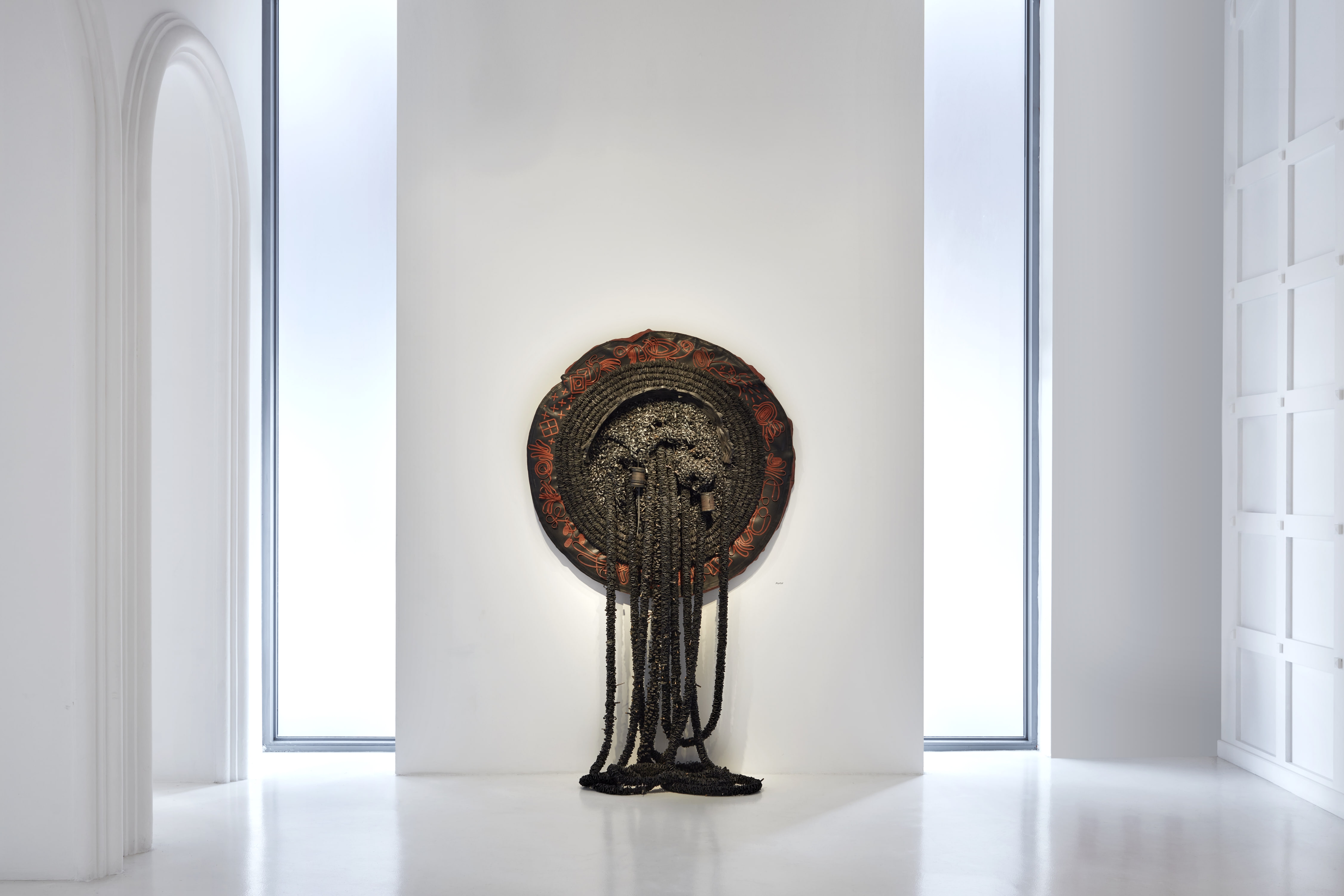
Used marks South African conceptual artist Usha Seejarim’s second solo with Southern Guild and inaugurates the gallery’s New York space in Tribeca. Bringing together a new body of sculptural and wall-based works, the exhibition extends Seejarim’s longstanding inquiry into gender and power, foregrounding the material and affective traces left by continual use.
Inspired by Sara Ahmed’s writing, Seejarim’s exhibition suggests ideas of “use” as something bodily, effortful, and repetitive, compelled to labour and the conditions under which bodies are made productive. Ahmed describes use as “a rather ordinary kind of verb, [one that] is often hard at work, a sweaty verb.” (1) For the artist, this encapsulates concepts of labour, ordinariness, and the abject, consistently emphasised in her three-decade-long practice.
At the centre of the exhibition is the relationship between labour and form. Seejarim works with repurposed domestic objects, reconfiguring them into accumulative sculptural fields that propose shared biographies. Domestic work, historically rendered invisible and feminised, is repositioned here as both subject and structure within broader social and gendered economies.
Works like An Unconcealed Truth (2019) exemplify this approach through the composition of hundreds of wooden clothespins arranged into dense, continuous form. One edge of the rectangular field appears irregular, interrupted by a protruding horizontal “flap” that partially conceals the surface beneath. Rather than securing privacy, this subtle disruption draws attention to what lies beneath, suggesting strain, vulnerability, even resentment. The attempted act of concealment becomes performative, revealing the instability beneath systems that rely on compliance within the domestic space.
Throughout the exhibition, the grid is employed as both compositional device and conceptual framework – a structure historically associated with order, rationality, and control. Yet in Seejarim’s work, the grid rarely remains intact. Repetition produces variation rather than homogeneity; alignment gives way to deviation. Circular and oval forms recur as counterpoints to rigidity, introducing cyclical temporalities that resist linear narratives of progress. These abstract forms evoke bodily registers without figuration, suggesting openings, lesions, or thresholds.
In A Persistent Wound (2025) and A Deep Wound (2024), clothespin-based surfaces are interrupted by gestural markings that resemble scars, threads, or veins. An ochre, smudge-like form emerges from the dense structure of A Persistent Wound, presenting injury not as a singular rupture but as an ongoing condition sustained through repetition and time. Similarly, A Deep Wound introduces a red line that cuts through the ordered field, suggesting lineage, inheritance, and generational trauma. These works speak to how experiences of harm are not always catastrophic or visible, but embedded within everyday routines. What persists is not only the wound itself, but the endurance required to live with it.


In A Small Crease (2025), stacked iron soleplates are configured into a monumental wall-based structure that exaggerates the very imperfection irons are designed to eliminate. The crease becomes a record of repeated pressure: a material archive of labour and accommodation. Rather than smoothing out the flaw, the work preserves and emphasises it, reframing imperfection as evidence of use and lived experience.
This body of work builds on concerns explored in Seejarim’s Servitude (2020 – 2025) series, where found serving trays, irons, and domestic implements are transformed into sculptural assemblages that interrogate the domestic sphere as a site of service, containment, and power. The polished silver trays are layered, slit, and folded to evoke vulvic forms, collapsing associations between caregiving and the regulation of the female body while exposing the violence embedded in systems of service structured through obligation and control.
Used also attends to the ways in which familiarity can obscure violence. The condition of being “used to” something renders structures of labour and care increasingly difficult to perceive or challenge. Seejarim employs abstraction as a critical strategy here, allowing these conditions to remain affectively present without becoming illustrative. Her works maintain ambiguity, resisting fixed interpretation while registering the subtle accumulations of pressure and resilience.
The body of work further introduces care as an organising ethic, emerging not as sentiment but material and relational practice. Drawing on bell hooks’ conception of love as an active commitment,(2) Seejarim reframes care as a structural force rather than an emotional condition. Her works do not seek to restore domestic objects to their original state, nor erase the traces of prior use. Instead, they hold those traces in place, allowing wear and deviation to remain visible.
In A Lingering Kiss (2025) and A Soft Word (2026), the sheath and internal components of ironing soleplates are constructed into abstract forms that evoke a sense of intimacy. Despite being metallic and cold, the materials communicate a softness that is almost sensual. The “kiss” and “soft word” implied by the titles are durational more than performative. This quiet sensibility positions care as a mode of resistance. Rather than opposing labour, these works reframe it, proposing that gentleness can coexist with effort, that softness can persist within structures designed for productivity and control.
In this sense, Seejarim’s work aligns with hooks’ understanding of love as inseparable from justice: an ongoing commitment to recognising and sustaining what has been historically overlooked, overused, or rendered invisible.
By suspending utility and foregrounding material trace, Used repositions the domestic sphere as central terrain through which social relations are produced and sustained, reframing everyday repetition not as a passive condition but as a site of critical inquiry, ethical attention, and quiet resistance.
(1) Ahmed, S. 2019. What’s the Use? On the Uses of Use. Durham, NC: Duke University Press, p. 21.
(2) hooks, b. 2000. All About Love: New Visions. New York: William Morrow.
For press queries, please mail [email protected]
Artist
Works

Usha Seejarim
Center Field, 2026Wooden clothes pegs, wire, wood stain
114.2 x 116.1 x 4.9 in. | 290 x 295 x 12.5 cm
Sold

Usha Seejarim
Centerfold, 2026Wooden clothes pegs, wire, steel
48.4 x 94.5 x 5.7 in. | 123 x 240 x 14.5 cm
Sold

Usha Seejarim
A Soft Word, 2025Reclaimed iron sole plates, timber
73.6 x 54.1 x 5.7 in. | 187 x 137.5 x 14.5 cm
Sold

Usha Seejarim
A Small Crease, 2025Reclaimed iron sole plates, steel
55.5 x 130.7 x 7.9 in. | 141 x 332 x 20 cm

Usha Seejarim
A Lingering Kiss, 2025Reclaimed iron sole plates, timber
73.6 x 56.5 x 3.9 in. | 187 x 143.5 x 10 cm
Sold

Usha Seejarim
Sacred Dog Ear, 2026Wooden clothes pegs, steel, wire
53.7 x 48.8 x 12.2 in. | 136.5 x 124 x 31 cm
Sold

Usha Seejarim
A Persistent Wound, 2025Wooden clothes pegs, broom heads
57.9 x 34.6 x 3.9 in. | 147 x 88 x 10 cm

Usha Seejarim
Blood Yoni, 2025Wooden pegs, wire, wood stain
45.3 x 43.3 x 7.9 in. | 115 x 110 x 20 cm

Usha Seejarim
A Deep Wound, 2024Wooden clothes pegs, wire, wood stain
51.2 x 37 x 3.9 in. | 130 x 94 x 10 cm

Usha Seejarim
An Unconcealed Truth, 2019Wooden pegs, wire, steel
32.3 x 33.3 x 7.5 in. | 82 x 84.5 x 19 cm

Usha Seejarim
Aftercare, 2026Wooden clothes pegs, wire, steel
40.9 x 59.1 x 3.5 in. | 104 x 150 x 9 cm

Usha Seejarim
Vulva Pudding, 2019Wooden clothes pegs, wire, steel
38.2 x 11.8 x 5.9 in. | 97 x 30 x 15 cm


Usha Seejarim
Servitude II, 2020Serving trays, found objects
10 x 9.2 x 6.9 in. | 25.5 x 23.5 x 17.5 cm

Usha Seejarim
Servitude III, 2020Serving trays, found objects
13.8 x 8.1 x 4.3 in. | 35 x 20.5 x 11 cm

Usha Seejarim
Servitude IV, 2020Serving trays, found objects
16.1 x 8.5 x 4.5 in. | 41 x 21.5 x 11.5 cm


Usha Seejarim
Servitude IX, 2020Serving trays, found objects
13.8 x 13.8 x 1.6 in. | 35 x 35 x 4 cm
Sold


Usha Seejarim
Soft Serve II, 2025Serving trays, found objects
18.5 x 15.8 x 5.1 in. | 47 x 40 x 13 cm
Usha Seejarim
Servitude III, 2020Serving trays, found objects
13.8 x 8.1 x 4.3 in. | 35 x 20.5 x 11 cm

Usha Seejarim
Ready to Serve, 2019Serving trays, found objects
18.1 x 10 x 0.8 in. | 46 x 25.5 x 2 cm

Usha Seejarim
Guided by Kali, 2025Serving trays, iron soleplates
16.9 x 13.2 x 2.6 in. | 43 x 33.5 x 6.5 cm
Sold

Usha Seejarim
Primal Power, 2025Serving trays, iron soleplates, found objects
31.9 x 12.4 x 4.9 in. | 81 x 31.5 x 12.5 cm


Usha Seejarim
Black Goddess, 2025Serving trays, found objects
16.1 x 13.8 x 5.9 in. | 41 x 35 x 15 cm